Nose in a book

Reviews and other ramblings

  • Home
  • Reviews archive
    • Book reviews
    • TV reviews
    • Theatre reviews
  • TBR
  • Challenges
    • The Classics Club
    • 2014 Popular-Science Reading Challenge
    • Cookery challenge
    • The Gilmore Girls Reading Challenge
    • 2013 TBR Pile Challenge
    • 2013 Translation Challenge
    • Crime and Punishment read-a-long
  • About
    • Cookie legal stuff
  • Home
  • Reviews archive
    • Book reviews
    • TV reviews
    • Theatre reviews
  • TBR
  • Challenges
    • The Classics Club
    • 2014 Popular-Science Reading Challenge
    • Cookery challenge
    • The Gilmore Girls Reading Challenge
    • 2013 TBR Pile Challenge
    • 2013 Translation Challenge
    • Crime and Punishment read-a-long
  • About
    • Cookie legal stuff

Tag: childhood

She thought she’d left her past behind

July 28, 2012

In Her Shadow
by Louise Douglas

I was sent this book on spec by the publisher, I’m guessing partly because it’s set in Bristol, or at least half of it is. But I must admit that I wasn’t entirely won over.

The premise sounded a bit woolly and to be honest, it was. Highly strung museum worker Hannah Brown has never get over the death of her best friend Ellen when they were 18, especially because she feels that she had betrayed her friend in some mysterious way. What appears to be a sighting of Ellen sparks off a long-drawn-out breakdown, or almost-breakdown, told in alternating chapters to the story of her childhood friendship with Ellen.

The characters are interesting and varied. As well as mousey matter-of-fact Hannah and exuberant arty Ellen there’s Ellen’s brooding, troubled father and Hannah’s sort-of-foster-brother Jago who is a gentle salt-of-the-earth type.

And there is quite a lot going on. In her youth Hannah nurtured an obsessive fixation on Ellen’s father, turning a blind eye to his failures as a father to her best friend. She also got pretty jealous over both Jago and Ellen. In the current day Hannah has a fixation on her co-worker John who is married, though not happily. And she’s having a meltdown.

Which all sounds like it could have been gripping. But somehow…it wasn’t. It was easy enough to read but there were no stand-out passages. The Bristol setting if anything annoyed me because it was slightly clunky, name-checking streets and locations constantly, rather than using more subtle descriptions that Bristolians would recognise anyway.

The Cornish setting was better, combining the romantic wild landscape and the mystery of a big rich house (Ellen’s) and the starker reality of working-class Britain in what I think was the 1970s and 1980s. Douglas showed some love for this setting, subtly dropping in local detail the way I would have liked her to in the Bristol sections.

The climactic reveal of the betrayal was actually better than I had expected, and made me dislike Hannah where up to then I had been on her side. I know the moment itself could be written off as a youthful mistake but she has spent years (16 or 17, I think) doing nothing to right the wrong.

There was some gothic, melodramatic potential for this novel but for me it didn’t deliver.

This book was kindly sent to me by the publisher in return for an honest review.

Published 2012 by Bantam Press, an imprint of Transworld Publishers.
Kate Gardner Reviews

11 random things about me

March 21, 2012

Whenever I get tagged by one of these things, I am torn. I have an age-old hatred of chain letters (remember when they were actual letters and you were expected to write the whole thing out 10 times?) but I like to learn more about my fellow bloggers and have no problem with sharing more about myself.

So, because Jo is so nice I will half-reply (and direct you to her far-more-interesting answers) but I won’t continue the chain (though if you want to carry it on yourself, feel free!).

Here goes…

1. I had glue ear when I was little and was almost entirely deaf by the time I turned 6. Thankfully, one operation, two grommets and a bunch of unpleasant wax-drainings later my hearing was completely restored. (Theories about how this may have affected the rest of my life or at least childhood could fill a whole series of blog posts.)

2. I was a quite-good gymnast as a child and am a trained gymnastics coach.

3. I have a phobia of fish.

4. My first foray into journalism was at primary school when I wrote, produced and distributed an environmental newspaper that I now sadly not only have no copies of but cannot even remember the name of.

5. I have been a vegetarian – for ethical/moral reasons – since I was 13 but when I was 17 I worked on the deli counter in the local supermarket and had no problem with skewering chickens for the rotisserie; indeed to this day I’m happy (well, okay with) pulling apart a chicken carcass. I am also very careful about food hygiene since that job.

6. My first job was doing my Dad’s filing. He would take me to work on Saturday mornings and before we left he’d log my hours in the petty cash book and pay me my wages. It was such a good gig I continued to work the occasional Saturday for Dad until I left home.

7. As a kid I always had a project on the go. I planned theoretical trips around the world. I made a database of kings and queens of England that was harder to refer to than the books I’d used as reference.

8. I used to cut out pictures from magazines that I thought might inspire my writing.

9. I was, briefly, a member of the Barbie Fan Club.

10. I once adopted a whale (or rather, it was a birthday present, but I asked for it specifically). She was called Scylla.

11. I have read Ulysses. I had to for the modernism unit of my English degree. I recognise its brilliance but did not enjoy the experience.

Apparently most of the things I think might be interesting about me date back to my childhood.

Kate Gardner Blog

Comfort reading

July 26, 2011July 26, 2011 4 Comments

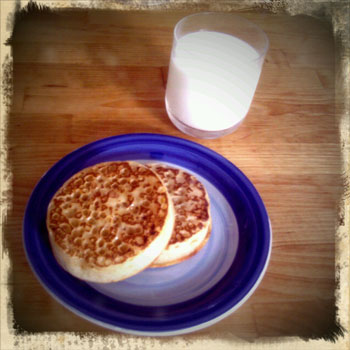
Crumpets and milk

One of my strongest sensory memories is the smell/taste of buttered crumpets, which takes me back to being very young (primary school) and sitting at the breakfast bar in the kitchen eating a snack while listening to an audiobook on cassette. My favourite audiobook was The Secret Garden and, even now, certain words (“wuthering” and “daffydowndilly” come to mind) can only be said in the voices I remember from that tape, with their Yorkshire lilt.

The Secret Garden

I don’t own a cassette player anymore, but I do still have that cassette because I couldn’t bear to throw it away. Thankfully I have the actual book too, for times when I really need comfort in my reading. (Like now – can you tell I’m feeling a bit lupusy? Yes, it’s a word.)

Kate Gardner Blog

What you do to survive

July 16, 2011March 11, 2012 1 Comment

In the Country of Men
by Hisham Matar

I got this book as part of an event at the Oxford Literary Festival in 2006. Penguin Books had won a bidding war over it and was therefore keen to promote this talented debut author. I think perhaps the big promotional push put me off. Certainly, it wasn’t until I started to hear about Matar’s second novel, published earlier this year, that I became interested enough to pick it up.

Of course, it’s now timely because Matar is Libyan and was writing here about the early days of Qaddafi’s rule…in fictional form. Young man Suleiman looks back on the summer of 1979, when he was nine years old and became aware that his father’s disappearances were not always business trips, and his mother’s sadness was more complicated than feeling lonely when her husband was away.

Child Suleiman is a bit of a dreamer. In his head he is the romantic hero of the Arabian Nights and will grow up to be a jetsetting art dealer. In reality he finds that it is far too easy to do what he is told and then regret it later.

This is a beautiful, well told story. There were times when I was surprised by Suleiman’s actions or his reaction to other people, and I had to remind myself that this was a nine year old boy, with a simplified view of the world that is straining under the weight of all that is happening around him. He’s confused and angry and trying desperately to be the good boy he was raised to be, which isn’t easy when “good” is a relative term.

The narrative device of older Suleiman looking back allows Matar to inject a little history and hindsight into the story but this never gets heavy-handed. For a book about awful, weighty subjects (and it’s really not just in the background), this is an accessible, gripping read.

First published 2006 by Viking, an imprint of Penguin Books. Shortlisted for the Man Booker prize in 2006.

UPDATE: See also the Guardian Books podcast with Hisham Matar (mostly talking about his new book, Anatomy of a Disappearance, but also touching on this one) and the World Book Club episode featuring Matar discussing this book (click on the link and scroll to September 2011).

Kate Gardner Reviews

A reader reads

February 13, 2011 6 Comments

Inspired by Wallace of Unputdownables‘ lovely post about how her mum was her biggest reading influence, I got thinking about people who were important to me in that respect. One of my big reading influences was my third-year infants teacher, Mrs Barkley.

She quickly cottoned on to the fact that I was not only way ahead in reading the official school reading scheme books, but I was bored and unchallenged by them. So she introduced me to her special book cupboard. That place was amazing! A lifetime’s worth of children’s books, mostly suitable for kids in exactly my situation. That’s where I discovered Mrs Pepperpot and Supergran and countless others.

She retired at the end of that year and we held a special assembly for her, with lots of ragtime classics, including “Any old iron”, “She’s a lassie from Lancashire” and the specially written masterpiece “Knees up Mrs Barkley” (to the tune of “Knees up Mrs Brown”, if you didn’t get that). I remember that for “Here am I waiting at the church” we dressed up in bridesmaid dresses (or the closest equivalent we had) and I discovered to my horror on returning to the classroom to change for the next number that I’d gone out on stage with my ordinary dress unzipped and hanging around my waist, underneath the frilly frock. I was lifted by the success of playing Jennifer Eccles in “Lily the Pink”, particularly because I was deemed not freckly enough and had huge freckles drawn on my face. (At the age of seven I was a little self-conscious of my freckles.) But the highlight was when we sang Mrs Barkley’s favourite song “When you’re smiling” and she cried. It may have been the first time I saw someone cry with happiness.

My parents also, of course, had their part in my love of reading. I am fairly certain I could read before I started school, which must have been down to them, mostly my Mum, but I also fondly remember Dad reading us to sleep (for some reason the only title I remember specifically being read to us is Danny the Champion of the World). They also read for themselves, though not voraciously, and there were always lots of books in our house. In later years I took to reading to my older sister when we went to bed, because I wanted to share my favourite books with her. I have no idea if she actually liked this or was just indulging her little sister.

In fact, my whole family reads. But there is a definite step change between them and me. I was always the bookish one, even if everyone had a book on the go. I would read while walking to school, while eating my meals, with a torch under the bedcovers after lights out. I would read the same book a dozen times and make a diagram of the characters’ relationships or a timeline of events. And for some reason I attribute this extra level of obsessiveness, this need to devour every book in sight, to my favourite primary school teacher. So thank you Mrs Barkley!

Kate Gardner Blog

Don’t open that door

October 24, 2010March 11, 2012

Coraline
by Neil Gaiman

This is one of that excellent trend of children’s books that don’t shy away from being scary or gruesome because, well, children like that kind of thing. I did. Far more so than I do now.

Coraline is a young girl who moves, with her parents, to a flat in a big old house one summer. Her parents rarely have time to spend with her and as the long holiday drags on she gets increasingly bored of rainy days with nothing to do and starts exploring the house and grounds until the only thing left is whatever’s behind the mysterious door in the drawing room. Despite cryptic warnings from the neighbours, Coraline finds a way to unlock the door and her ghostly adventures in a strange new world begin.

The story is excellent and the characters brilliant, either ghoulish or eccentric apart from Coraline herself, in that slightly exaggerated manner that makes sense in children’s books. The other world is cleverly imagined, starting off as a bright, attractive place and gradually becoming stranger and scarier. Coraline is a strong heroine who learns to appreciate her slightly absent parents and to solve problems for herself. The language is very simple, in fact possibly simpler than is strictly necessary. It reads like a children’s book and as an adult I found the language a little offputting. Clearly I am not the target audience but I do think perhaps Gaiman has tried too hard to distinguish this from his more adult fiction.

However, I did enjoy it. I genuinely flinched at the scarier moments and laughed out loud at some lines. I loved the downstairs neighbours, two retired actresses whose talk of treading the boards and famous Shakespeare quotes make no sense to Coraline but might to a well read (or read to) child. The main villain is chilling and original and described well enough to picture – the illustrations by Dave McKean help, of course. I would not hesitate to recommend this for a child but not necessarily to an adult.

First published 2002 by Bloomsbury.

Kate Gardner Reviews

Bizarre like wasabi chocolate

September 2, 2010March 11, 2012 1 Comment

The Character of Rain
by Amélie Nothomb
translated by Timothy Bent

I discovered Amélie Nothomb five or six years ago and I love her quirky style. Her books are novels and yet in most of them she casts herself as the main character and uses her own life for the bare bones of the story. She has a surreal sense of humour and, assuming any of it’s true, an interesting life to draw upon.

This book covers Nothomb’s first three years, which were spent in Japan where her father was the Belgian consul. The very fact that her main character is so young and yet narrates in the first person suggests that the story must be mostly fiction, and that’s before taking the heavy Kafka references into account.

The early part of the book covers the first two years in immensely strange fashion and could not possibly be considered to be a serious straight of-this-world story, but rather an odd analogy for the development of the ego – as I said, Kafkaesque. This is also borne out in the French title of the book: Métaphysiques des tubes – the Tube being her metaphor for a baby (things go in one end and come out the other, with not a lot else going on). I’m not sure if us Brits are considered less au fait with philosophy and the nature of things or if the UK publisher just found that title too plain weird.

The bulk of the book deals with the third year in the child’s life, giving the book an ending point that has particular significance in Japan. Traditionally the Japanese believe that children are gods until the age of three, at which point they fall from grace and join the rest of mankind. Nothomb briefly recounts this belief partway through the novel but it is clearly the basis for the entire story.

The child is introduced to us as God. As it becomes self-aware, it narrates as though the world revolves around it – “naming” people and objects, for example, through its first words. If these were truly the thoughts and actions of a two-year-old child it would be an extremely precocious toddler, and maybe Nothomb was, but more likely the far-too-adult speech is used to convey the point – the child gradually becoming aware of more of the world and, even at this early age, losing some of its security. There is also a lot of secrecy, of “me versus the world” which, as far as I remember, is a pretty accurate way of describing childhood.

There is an extent to which this book is also about Nothomb’s love for Japan. Her family left Japan when she was five and she returned there for a few years as an adult. The land of her birth clearly holds a special place in her heart and this is eloquently conveyed in the intense, passionate voice of the child.

The English title, by the way, has a neat little etymology of its own. “Rain” is one of the meanings of the kanji character for the child’s name (it would be interesting to know if the word actually is said “amelie” – anyone know?) so the title could just mean that this is about the development of a character called Rain. However, the child is also a water-lover and holds a particular fondness for heavy summer rain, imbuing it with various significances.

For a short book, this isn’t a light read but it is enjoyable and stays just this side of too plain weird for my taste.

First published in France in 2000 by Editions Albin Michel.
First published in Great Britain in 2004 by Faber and Faber.

Kate Gardner Reviews

Twanging those heartstrings

July 18, 2010March 11, 2012

Me & Emma
by Elizabeth Flock

This book grew on me slowly. At first I found it a little annoying, like it was trying too hard to tug on the reader’s emotions, but then I got caught up in the story and by the end I was thoroughly enjoying it and impressed, even.

It’s narrated by eight-year-old Caroline, or Carrie, who details her life in North Carolina in her diary, or at least that’s how it’s initially presented (it doesn’t really make sense because there’s flashbacks, but I’ll let that go). Carrie daydreams a lot and loves her little sister Emma to distraction but the telling moment is when she declares that she doesn’t mind school because it gets her away from home.

Home is not a nice place for Carrie. Her stepfather is a violent drunk who coerces Emma into his bedroom frequently. Carrie’s mother either ignores or excuses the abuse and is not above beating the girls herself. It’s a shockingly horrible life and I suppose it’s a tribute to the author to say that it’s not a chore to read – somehow it’s not all negative, there’s lots of positives, at least the way Carrie sees it.

The characterisation is excellent, certainly in the case of Carrie. The prose is pretty realistically the voice of an eight year old. At first I found it a bit wearing, because eight year olds don’t have the greatest vocabulary and they do repeat annoying slang phrases and Flock has captured that very well. Thankfully she hasn’t misspelled it all realistically but she has used North Carolina vernacular.

This isn’t the greatest writing or the deepest of books and the storyline is likely to affect you more than the prose but it isn’t a bad read. Certainly better than I expected from the first few pages.

Published 2005 by Mira Books.
ISBN 978-0-7783-0084-7

Kate Gardner Reviews

Family matters

April 2, 2010 2 Comments

This week I have been preoccupied with family. My sister is visiting from the US for the first time in over three years so we are spending lots of time catching up, wondering whether to visit some sights or just carry on chatting. Talking is winning, partly thanks to the abysmal weather.

I have always been a person to rate my friends over my family but that’s not to say I don’t love my family. We’re not that similar as people but we obviously have shared history and I know from experience that my family will always be there for me, no matter what. I like to think my friends would as well but I haven’t tested them nearly as thoroughly!

There’s a great comfort in turning up at my childhood home and letting that huge catalogue of memories wash over me. It’s changed but is still the same. I know every picture on the walls and the history behind them, even as the furnishings gradually get replaced. I know each contour of the garden and where things are kept in the kitchen. At my Dad’s encouragement I help myself to food and drink at all times of day and night like I’m a teenager again. I scan through the bookshelves lovingly, picking out books from my childhood or degree course that ended up here.

It must be quite different for my sister who left home younger than I did and has been back far less frequently. She doesn’t know the story of the “best cutlery” in the box under the sofa and far fewer of her belongings are scattered around here, muddled up with everything else. I must talk to her about this tomorrow.

My sister and I are close in age and, perhaps for the first time, at essentially the same place in our lives, so we have a lot to talk about. It’s fun to chat as adults (although there’s still plenty of whinging about parents) and we relate better now than we ever have before. That said, seeing so little of one another puts us in that awkward position where we’re not familiar enough with each other’s daily life, friends, boss, etc to discuss them freely the way you can with friends you see all the time. And having such a short time together means you avoid any potentially touchy subjects. I know that my sister and I are capable of fighting – we shared a room for most of our childhood!

Still, it’s been great to have this time and I will be sad on Sunday when she’s gone. Will definitely have to add “Save up money and annual leave to visit Ruth next year” to the to do list.

Kate Gardner Blog

On being a book lover

March 5, 2010 8 Comments

I love to read. I mean, I really love to read. I was that child whose parents had to wrestle the book from my hands at the dinner table to get me to eat, who had to seriously weigh up severe car travel sickness against the awful idea of a (sick-free) journey without reading, who read almost every book at the local library so was greatly relieved when they largely restocked in my early teens, who in a recent house move packaged up my most beloved books more carefully than the crystal wine glasses. In my defence I know that Debenhams still sells those glasses.

The point is that I write about books because I love them. I love the look, feel and smell of them, old and new. I love the shape of words on a page. I love the language of books: folio, typography, endpapers, head and tail bands.

But mostly I love to read. As a grown-up I read a lot less than that book-obsessed child I once was, because reading has to fit around work and housekeeping and socialising and all the rest of it, but reading is still a great pleasure, a guaranteed escape to a good place (no matter what the book is about).

My favourite books is an ever-changing list, partly because there are so many great books out there. But my favourite ever grown-up book is probably Sophie’s Choice by William Styron.

My favourite books as a child were much more clearcut. They were:

  • The Ghosts of Motley Hall by Richard Carpenter
  • Alpaca by Rosemary Billam
  • Carbonel by Barbara Sleigh
  • The Wickedest Witch in the World by Beverley Nichols
  • The Jolly Postman by Janet and Allen Ahlberg

Plus I also devoured everything by Roald Dahl, Colin Dann, Brian Jacques, Noel Streatfield and Frances Hodgson Burnett over and over again. Which is probably a more sophisticated list than the five I’ve picked out above, but taste is taste and they were my absolute favourites.

It’s personal, it’s about you the reader as much as anything else, it can be hard to put a finger on. I rate enjoyment of a book separately from quality of writing or storyline or characters because sometimes an author does everything well but I still don’t enjoy the book. And vice versa.

So, without further ado, my first Nose in a book review is here.

Kate Gardner Blog

Posts pagination

1 2

Archives

RSS Nose in a book

  • Book review: Interstellar Megachef by Lavanya Lakshminarayan
  • May 2026 reading round-up
  • Book review: Passing by Nella Larsen

Me on the internets

  • @kate_in_a_book@mas.to (Mastodon)
  • Flickr/noseinabook
  • Instagram/kate_in_a_book
  • StoryGraph/kate_in_a_book

Categories

  • Blog
  • Reviews
  • Uncategorized
Proudly powered by WordPress | Theme: Dream by vsFish.