Nose in a book

Reviews and other ramblings

  • Home
  • Reviews archive
    • Book reviews
    • TV reviews
    • Theatre reviews
  • TBR
  • Challenges
    • The Classics Club
    • 2014 Popular-Science Reading Challenge
    • Cookery challenge
    • The Gilmore Girls Reading Challenge
    • 2013 TBR Pile Challenge
    • 2013 Translation Challenge
    • Crime and Punishment read-a-long
  • About
    • Cookie legal stuff
  • Home
  • Reviews archive
    • Book reviews
    • TV reviews
    • Theatre reviews
  • TBR
  • Challenges
    • The Classics Club
    • 2014 Popular-Science Reading Challenge
    • Cookery challenge
    • The Gilmore Girls Reading Challenge
    • 2013 TBR Pile Challenge
    • 2013 Translation Challenge
    • Crime and Punishment read-a-long
  • About
    • Cookie legal stuff

Tag: London

The person you thought you knew

July 23, 2012 4 Comments

The War of the Wives
by Tamar Cohen

I was intrigued by this book from the synopsis and I am left feeling very smug that I know myself well – because I loved it. It isn’t perfect but it is gripping and thought-provoking, and story and character are equally strong.

To save you even having to read the blurb, the tagline on the front of this book tells you all you need to know (when did books start having taglines? Is that a thing now?): “At your husband’s funeral you don’t expect to discover his other wife.” So it’s about grief, lies, family, bigamy, but also modern life in London and how change can make you realise what kind of person you are.

The storytelling is narrated alternately by the two wives, Selina and Lottie. Initially there’s a little bit of stereotyping. Selina is well off, uptight, a kept woman who keeps her very nice, very big house in Barnes in impeccable order and doesn’t check the price tag before buying yet another cashmere coat. She was married to Simon for 28 years, they have three children, aged 17 to 26, and while there’s not really any passion left she still loves her husband. She worries about ageing, her children’s choices of partner and why her youngest son insists on eating junk food.

Lottie is artistic, but illustrating children’s books isn’t making her a living so she also has a job she dislikes in a hotel. She lives in a flat in North London with her and Simon’s daughter Sadie, who is 16 and very difficult. She and Simon were married 17 years and they were still very passionate about each other, though they had money troubles and they fought a lot.

Cohen takes as her structure the five stages of grief. So the wives’ hatred of each other and what Simon did really comes to the fore in the “Anger” section. And the book inevitably wraps things up in the “Acceptance” section. Which was where, looking back, I feel a little disappointment. A lot of mysteries turn out to have been red herrings, which I should have seen coming when a potential major storyline just didn’t go anywhere. But what this does is keep the focus on the families, which is definitely Cohen’s strength. That and her fantastic turn of phrase that can combine urbanity and sentiment in clever, often comic, ways:

“I know how you can think you know someone, really know someone, only to find the person you thought you knew turns out to be a hollow timber structure with someone entirely different inside – a plastic wheelie bin of a someone.”

I liked the depiction of the children through their mothers’ eyes. I liked the way the women developed from the stereotypes they saw each other as being into complex, interesting characters. I liked the ultra-current setting – not just Twitter and Facebook but also preparations for the London 2012 Olympics – but I do worry that it will date the book quickly. I suppose that’s a decision the writer and her editor have already made.

The main flaw, I would say, are the prologue and epilogue, which is a shame because they are the first and last impressions. I found the epilogue especially jarring and completely lost my hold on the fictional world I had until then been enjoying thoroughly. But the rest of the book is good enough to forgive the slight lapse.

This book was kindly sent to me by the publisher in return for an honest review.

Published 2012 by Doubleday, an imprint of Transworld Publishers.

Kate Gardner Reviews

Sunday Salon: Holidaying

June 3, 2012 8 Comments

The Sunday Salon

It’s been a busy busy week. Amazing how much more you can do when you don’t go to work! Okay, so I’m on holiday for a week and a half, which we are filling with three short breaks in a row. We seem to have managed once again to coincide our plans with glorious sunshine, which is not strictly good for me but I love how happy it makes everyone.

Part 1: London
In London, we went to museums with Tim’s parents, watched fox cubs playing from a friend’s balcony and sat reading in royal parks.

Urban fox

Part 2: Bristol
Then we came back to Bristol and enjoyed our city at a slower pace, took in a film at the excellent Watershed and went on a day trip to see the amazing sand sculptures in Weston-super-Mare.

Grumpy

Part 3: Melton Mowbray
Finally, we hopped on a train to Leicestershire to chill with friends in the countryside, which is where we are now.

Red

I am relaxed, I have done lots of reading (you can read my reviews of Enduring Love and Mr Fox, posted earlier this week) and I didn’t have to dip into my savings. Who needs fancy foreign holidays? (I’m not saying I never want one again. Just to be clear, I still want to see the world. But this has been a good holiday. That is all.)

Kate Gardner Blog

Happy Dickens Day!

February 7, 2012February 11, 2012 3 Comments

Night Walks

Night Walks
by Charles Dickens

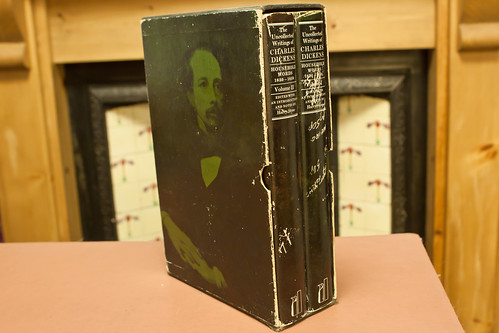
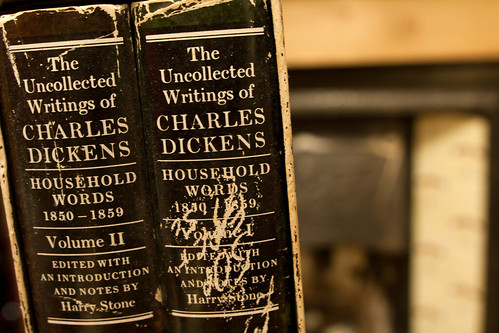
Today is the 200th anniversary of the birth of Dickens, so in preparation I thought I should read at least one of his works that have been sat on my TBR far too long. This is a collection of his essays, most of them from his journal Household Words, which I have a beautiful old boxed set of in my library. They give great insight into Dickens the man, as well as Dickens the writer.

The essays are mostly about Dickens’ forays around London, particularly poorer areas. His social conscience comes through strongly. In fact, he almost seems to be a bit of a busybody, inviting himself into workhouses and people’s homes, dragging children out of the gutter and throwing accusations at the police and government. But in the context of the time, writing such as this was hugely important. He described the real, actual conditions that people in London lived and worked in to spread the word, to spread awareness.

The writing is the Dickens familiar from his novels but with a single theme at a time making him a touch more accessible. There’s a definite sense of humour and a love of people in all their variety, as well as a need to know London thoroughly, at its best and worst. I found myself touched, amused, surprised and informed. Anyone interested in Victorian London would find something here for them.

Dickens Day

Some Dickens Day reading

First published 1850–1870.
This collection published 2010 by Penguin Books in the Great Ideas series.

Kate Gardner Reviews

The perils of social mobility

January 9, 2012 3 Comments

Pygmalion
by George Bernard Shaw

For some reason, despite loving the film My Fair Lady, I was convinced that this, the play it is based on, would be a bit stuffy and clever-clever. I had no idea how close the film is to the original script, with many of its funniest lines being Shaw. If anything the play is even funnier.

I read this book very carefully, because I was reading a 1947 Penguin edition printed on Bible-thin paper that felt as though it might disintegrate any moment. Though produced cheaply for a mass audience, it is still a thing of beauty, with illustrations by Feliks Topolski, extra scenes written for the 1938 film, a prologue and epilogue by the author, not to mention lengthy interjections from him at the start of most scenes. This is definitely not what reading a play usually feels like.

Bernard Shaw’s tongue is firmly in cheek from the start, with an attempt to write Eliza’s accent abruptly stopped partway through the first scene with the interjection “Here, with apologies, this desperate attempt to represent her dialect without a phonetic alphabet must be abandoned as unintelligible outside London”.

Professor Higgins is, of course, lovably eccentric, bad tempered without realising it and single-minded to boot. He and his friend Colonel Pickering are confirmed bachelors who deliberately ignore all raised eyebrows at them taking a young pretty girl under their wing. Eliza is an impressively strong female character. She has been supporting herself by selling flowers and calculates that if she submits to the professor’s tutelage she can earn a little more in a flower shop. She gets angry when she realises that they have made her appear too refined for such work and only suitable for marriage. She doesn’t want to rely on a man to look after her.

I don’t usually like reading plays; I find it difficult to lose myself in mere dialogue, but in this case Shaw’s interjections/scene settings are so long and descriptive that I almost forgot it was a play. As a bonus, there is an epilogue in which Shaw explains what comes next for Eliza and the rest of the cast, and why it is not the ending that many fans of the play and film might expect. It’s a very nuanced, interesting conclusion.

In short, I loved this and now want to watch the 1938 film, though mostly I want to watch My Fair Lady again.

The play first produced in Berlin, 1913; in London and Paris, 1914.
The film first produced 1938.
First published 1916.
Film version published by Penguin Books 1941.

Kate Gardner Reviews

Secrets and gangs

December 4, 2011December 4, 2011

20 Years Later
by E J Newman

The synopsis of this book greatly appealed to me – a story for young adults about people trying to survive in London 20 years after a mysterious event has destroyed humanity as we know it – so I jumped at the chance to get an advance copy. I may also have been attracted by the fact that one of the rival gangs in the story is called the Gardners. Sadly they turned out to be nasty nasty people. Darn.

Newman does a good job of eking out the details, both of what happened in the past and of what is happening now. The central characters are all 15 years old (or thereabouts, they don’t really know; they don’t bother with such things in this version of the year 2032) and therefore never knew the world before “It” happened, though there are older people around who occasionally drop a fact or two.

The story starts with Zane, a boy living with his mother Miri in an uneasy truce with two of the neighbouring gangs – the Bloomsbury Boys and the Red Lady’s Gang. They are unusual for not being part of a gang themselves and are often caught in the middle of vicious animosities. Zane’s longing to belong makes gang membership seem attractive but he is aware that he is not like other boys – he has an instinctual hatred for violence.

When Titus and his sister Lyssa stray unknowingly into Bloomsbury Boys territory a chain of events begins that leads Zane to the truth behind everything – including the fact that he is different from other people in more than just his attitude to violence.

I am reluctant to reveal much more than that, though the publisher’s blurb on the back cover gives away almost everything. I hate that. But it didn’t stop me enjoying the story. Actually, I raced through it, eager to know what happened next. A lot is packed into just over 300 pages and there are sequels in the works, so there were questions left unanswered and story threads left hanging.

One thing that stood out was that these 15 year olds are very different from the teenagers I have ever known, but this is a clear authorial decision. These characters are fighting for their lives, literally. They have no formal education, no early years of being carefree children; their intellect is dedicated to self-preservation, mastering weapons and early-warning systems. Most of the boys have never met a girl (aside from Miri) and so have never faced that side of being a teenager. Which makes them oddly childish; in fact one adult character in the book remarks on how young Zane is, compared with when he was a teenager, back before It happened. It makes the characters an odd combination of capable and self-reliant beyond almost anyone I know, and shockingly but sweetly naïve.

If you’re thinking that the author’s name seems familiar, why yes this is the same “E Newman” of the Split Worlds project. You see, a couple of months ago, I saw a Tweet from a local author about something called BristolCon, which sounded fun (and indeed was) and also that she would have copies of her new book there for reviewers. So I went along and I picked up a copy and then it was NaNoWriMo so I didn’t do a whole lot of reading for a month but I did interact with @EmApocalyptic and read a bunch of her short stories (and indeed featured one on this website). I am glad that I finally had time for her novel and look forward to the sequels.

Published 2011 by Dystopia Press.

Kate Gardner Reviews

Another vague drifty one

August 28, 2011May 9, 2015

Saving Agnes
by Rachel Cusk

I picked this up while in the US on holiday. I had read and enjoyed Cusk’s second novel The Temporary, which it turns out has rather a lot in common with this title. Possibly too much.

Agnes Day (which is a great name for a heroine) is drifting. She doesn’t really care about her job, feels distant from her (somehow still active) love life and even her friends. She lives with two former schoolmates in a house that is on the brink of being condemned, thanks to a large crack in the wall. This crack acts as a literal (and slightly over-obvious) representation of Agnes’s inner life.

Agnes is one of those heroines who frets about everything, is convinced everyone else is normal while she is abnormal and reminisces fondly about her teenage years when she came close to suicide because at least she was more decisive back then. I did not warm to her. Which is perhaps odd because I’m an over-thinker myself, but I like to think I’m also practical and Agnes is certainly not that. She seems to expect some magical change to just happen to her life, rather than going out and making it happen. She’s also one of those annoying people who take up causes without really learning about them. Even when challenged about this she doesn’t recognise her own failure to engage. And she’s self-absorbed, taking some serious jolts to notice the people around her.

There is an art to creating such a vague, drifting character. For much of the novel Agnes talks about her current relationship and her previous one interchangeably, so that it can be unclear which one is the subject, though what does gradually becomes clear is that Agnes’s attitude to relationships is unorthodox.

Cusk is…wordy. Her prose is beautiful but obscured by long, convoluted sentences:

“Agnes lay in bed waiting for the telephone to ring, believing as she did that the former event would precipitate the latter. Her faith, though gritty, was, she knew, ill-founded, attempting as it did to harness the perversity of the universe and make consistency where there was essentially none. By taking upon herself the task of second-guessing ill-fortune, she was in fact violating the creed of her anti-faith, which, if its principles were to be understood, would presumably visit her only at her own inconvenience…” [This goes on for two full pages before we learn whether or not the phone rings.]

I remember liking The Temporary but with very similar reservations – it also is about a disaffected woman in her 20s drifting, hating London (there is no love for the setting here) and being generally self-absorbed. However, the writing is good and Agnes is completely realistic (lesser characters aren’t quite fully realised but this is actually a believable portrayal of Agnes’s picture of the world).

First published 1993 by Macmillan.
Winner of the Whitbread First Novel Award 1993.

Kate Gardner Reviews

A bit of festive cheer

December 24, 2010March 11, 2012

Comfort and Joy
by India Knight

Some people might classify this as chicklit, not my usual genre, but as Dervla would say this time of year, this is no ordinary chicklit; this is chicklit that absolutely completely struck a chord with me. Plus, it’s Christmassy.

Clara is 40 and is scrambling around Oxford Street on 23 December to complete the perfect Christmas she has planned for her 16 guests, including her three children, husband and ex-husband. The book follows her through the ensuing mayhem of family, friends and Christmas.

Knight mercilessly mocks the middle-class boreishness. I mean, these people are London middle class, which is a whole separate sub-class of its own. They obsess over the provenance of their food (in fact, food in general) and PTA meetings and how to give their children everything without spoiling them. Clara herself is painfully aware that these are not issues most of the world has the luxury of worrying about and besides, she finds it boring. What happened to those youthful days of discussing politics?

There are some painfully real moments and Clara can be a little vicious in her own mind, but she loves the people around her and this shines through. Her sisters are particularly wonderful characters and their shared history and language are joyous to be part of.

I laughed out loud many a time but I also appreciated the main “lesson” that Clara learns – that your true family is the one that’s there for you, the people who “taught me to swim, and everything that that’s shorthand for” as she puts it. Broken marriages and jumbled extended families may be nothing new but I suspect there’s still a lot of people out there trying to negotiate the tricky waters of which parents, step-parents, half-brothers and ex-step-granddads they keep in touch with. It’s always nice to know that someone else is struggling with the same issue.

Knight has got right into the Christmas tradition by writing about Christmas past, present and future. I loved that touch, though the future Christmas was rather less bleak than Dickens’. If you’re not one for making a fuss about Christmas, this may not be the book for you. But I loved it. I stayed up far too late into the night to finish it and then felt a little sad that it was over so soon.

Merry Christmas and happy holiday reading!

Published 2010 by Penguin.

Kate Gardner Reviews

Under their skin

November 7, 2010March 11, 2012

The Black Album
by Hanif Kureishi

Despite having been written 15 years ago, this book is very relevant to the world of today, giving a frighteningly believable insight into the world of British Asians. I say “frightening” because the story’s main theme is Muslim fundamentalism and it definitely gets scary.

Shahid was raised in well-to-do south-east England and moves to London to study at college and get away from the family business. He is tired of being looked down on for his bookishness and wants to experience “real life”. Quiet and studious, he finds himself a little lonely and excluded, so when a group of British-Asian neighbours led by the charismatic Riaz reach out to befriend him, he is eager to please them. Although it is clear from the start that the relationship is all about what they can get from him (his clothes, his typing skills, his links to some college professors, his good looks) Shahid doesn’t seem to notice the bizarre nature of their interaction and agrees to everything he is asked, even when it places him in danger.

At about the same time, Shahid’s favourite college professor Deedee prompts the start of a relationship that is almost the opposite in nature – it is loving, giving, free-spirited, frenzied, with a cacophony of drugs and wild parties interlaced with their bedroom adventures. It is against college rules, which concerns Shahid, but it is also against Allah, which concerns his new friends and his life turns into a tug of war between the two.

Set in 1989, one of the main storylines is the fatwa against Salman Rushdie for writing The Satanic Verses. Though he and the book in question are not named directly, his previous works are and the themes of the book are discussed a lot. The fundamentalist group are keen to get behind the fatwa and have the book banned in their district, despite not having read it. This is the point when Shahid tries his hardest to stand up to them, touching as it does directly on something that he loves dearly. The other time that he argues hard in favour of something is when he is asked to give up his music collection, including his dearly beloved Black Album by Prince.

The central themes of religious groups trying to change the world to fit their views and book banning/censorship are interesting ones but frustratingly, as is too often the case in life, they are not really debated here. Too few of the characters are willing to openly debate matters so attempts at discussion quickly flounder.

What this book does not include – and I would have to guess that this is deliberate – is any more moderately religious characters. There are fundamentalists and there are non-believers. At one point Shahid’s sister-in-law berates him for going to the mosque to pray, saying that she thought he was raised better than that. The viewpoint is very much that religion is for the uneducated, the great unwashed, and is essential to teach them basic morality and keep them in line. But once a person has money and education it becomes useless, or worse, dangerous.

In fact there are few if any moderate characters. Deedee’s life is outrageously liberal, a sea of raves, sex and drugs. Shahid’s brother Chili also seems to be caught up in this world of drugs and is spiralling downward from what was once a comfortable married life. I suppose this is to make Shahid’s choice more even, because he is so level-headed and rational that it would be hard to believe he’d stay involved with the fundamentalists if he had a more straightforward alternative. But that might also be a more interesting story, if the author had had to dig down into what would keep Shahid with the “brothers” if the alternative wasn’t a level of drink and drugs that’s beyond the average student life, so far as I’m aware. Maybe the author is trying to be equally stereotypical on both sides of the coin. There are no greatly sympathetic characters.

The threats and violence escalate, making this work better as a thriller than as a social study. There is a prescient storyline about a bomb in a London tube station and Shahid walking miles across the city in the aftermath. It’s never clear whether the bomb is related to fundamentalism or race tensions, but that’s certainly the implication.

There are moments of humour. The book begins with one of the “brothers” persuading Shahid that he has lost all of Riaz’s clothes, so Shahid will have to give him all the clothes he wants. Later on a local Muslim claims to find a message from God in an aubergine and the vegetable becomes a minor attraction, with attempts to get in installed in the town hall. But each of these is bound up with threats and violence, so that the ridiculous becomes something more frightening than if it were rational.

It’s a well written book, full of passion and anger, but it’s not an easy read. I found it hard to sympathise with Shahid for getting into trouble by failing to say no at key points. He is too meek and obedient a hero for my taste, though that’s probably supposed to be a product of his upbringing.

Published 1995 by Faber and Faber.

Kate Gardner Reviews

Posts pagination

1 2

Archives

RSS Nose in a book

  • Book review: Interstellar Megachef by Lavanya Lakshminarayan
  • May 2026 reading round-up
  • Book review: Passing by Nella Larsen

Me on the internets

  • @kate_in_a_book@mas.to (Mastodon)
  • Flickr/noseinabook
  • Instagram/kate_in_a_book
  • StoryGraph/kate_in_a_book

Categories

  • Blog
  • Reviews
  • Uncategorized
Proudly powered by WordPress | Theme: Dream by vsFish.