Every sort of trouble I can think of, we’ve tried it out
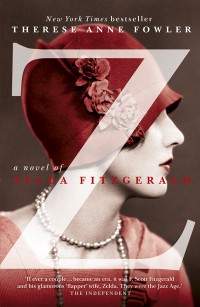
Z: a Novel of Zelda Fitzgerald
by Therese Anne Fowler
In case you missed me effusing on Twitter, I loved this book. A lot. I picked it up on a whim in a bookshop, having heard nothing about it and with no idea what to expect. I only knew that I was interested in the subject matter, but of course that was no guarantee. It was a good whim: I was engrossed and tore through it, then regretted having read so fast.
This is a work of fiction, but Fowler did a lot of research, reading diaries, letters, articles and interviews from Zelda and F Scott Fitzgerald and their friends, in order to reach her own interpretation of Zelda’s character. What she came up with was a character I felt I had a lot in common with – I know, I’m not an obvious comparison to the original flapper and embodiment of the jazz age, but such is the skill of a good writer!
The story follows Zelda from the day she first met Scott until her death, and the life they led was pretty exciting and event-filled, so on reflection a lot has been squeezed into these 350 or so pages, but it never felt rushed or crammed at all. Fowler has somehow given Zelda space to reflect and reminisce rather than just telling her story event by event, and by doing this the character comes truly alive.
“Before Scott’s success, before people everywhere had been ravaged by war and flu, there’d been little glamour in the literary world. To be a writer then was to be a drab little mole who thought big thoughts and methodically committed them to paper…With this group, though…and the postwar push for life, for fun, for all the things Scott and I were seeking and embodying, the literary world put its foot into the circle of the entertainment world’s spotlight.”
First of all, this is a story about true love. Although their marriage was far from perfect (in fact, arguably they were destructive for each other), Scott and Zelda were unusual among the circles they moved in, in that they were indisputably the love of each other’s life. This is backed up by the fact that, though this is a book in Zelda’s voice and very clearly on Zelda’s side, so that at times Scott is the bad guy, for the most part he is also a warm, relatable character, albeit one with a long long list of flaws! But then the portrait of Zelda acknowledges her flaws too. Until her health problems slowed her down, her drinking and partying was as out of control as Scott’s. They both struggled psychologically with feelings of inadequacy and failure – though for Scott this alternated with him being convinced he was a genius.
As those who know Zelda’s story will already be aware, it is psychological problems that give her and Scott an air of tragedy. She clearly suffered with mental health issues, but, from this novel at least, it seems that perfectly manageable issues were blown up into huge problems by a combination of stigma, prejudice, misdiagnosis and outdated treatments. Add to this Scott’s alcoholism and the intense jealousy that both felt, and you have a situation that was never going to end well.
“There’s a word for people who move from place to place, never seeming to be able to settle down for long: peripatetic. And there’s a word for people who can’t seem to stay out of trouble—well, there are a lot of words for such types…Every sort of trouble I can think of, we’ve tried it out—become expert at some of it, even, so much so that I’ve come to wonder whether artists in particular seek out hard times the way flowers turn their faces toward the sun.”
But for a while there, Scott and Zelda were on top of the world. They were very young when fame hit – they married when Zelda was 20 and Scott 23, and were hitting the headlines and gossip columns pretty much immediately. Fowler does a good job of showing the glamorous, romantic side of fame and the jazz age while acknowledging that Scott and Zelda were never truly as happy or carefree as they seemed to the outside world. She also acknowledges the very many famous names the Fitzgeralds befriended, without it ever feeling like namedropping.
Certainly, I am pre-disposed to like stories about all those artists in Paris in the 1920s, but that’s actually quite a small part of the overall story. What really gripped me most of all was Zelda’s aspiration to be an artist herself, independent of Scott. She was a writer, painter and ballerina, and dearly wished to fully become one or all of those things, but Scott never properly gave her his support. Time and again he would stop her from doing something she loved either in the name of her health or in the name of being a wife and mother. Admittedly, this is Fowler’s interpretation of the situation, but to me it felt that Zelda was a woman born 50 years too soon. Of course there were women in the 1920s (and long before that) working as writers, artists and dancers, but they had to be willing to completely split from conventionality, and Zelda loved Scott too much to risk losing him by doing something he so thoroughly disproved of.
“Imagine your body is youthful, firm, a pleasure to live inside of—and you’re wise enough already to know that this is fleeting, this body and its condition. It won’t last. None of it will last. And because it won’t, you allow the beautiful person who seeks you out to become as much a part of your day, a part of this place, as the poppies that grow beside the rocky path…You let it happen because all of it is illusory anyway.”
Fowler has done a wonderful job of giving Zelda a lyrical, living voice that transported me in time, place and emotions. Her Zelda is difficult and destructive but also wonderful and alive, so that her story is all the more heartbreaking.
So aside from the clunky and possibly misleading subtitle (is it just me or could that be interpreted as “a novel by Zelda Fitzgerald”?) I loved this book thoroughly and recommend it heartily. Predictably it has made me want to read Zelda’s own fiction and indeed more of Scott’s work too. And it’s made me feel a lot better about finding Hemingway mostly too brash and macho!
Published 2013 by Two Roads, an imprint of Hodder & Stoughton.
Source: Foyles, Bristol.