Nose in a book

Reviews and other ramblings

  • Home
  • Reviews archive
    • Book reviews
    • TV reviews
    • Theatre reviews
  • TBR
  • Challenges
    • The Classics Club
    • 2014 Popular-Science Reading Challenge
    • Cookery challenge
    • The Gilmore Girls Reading Challenge
    • 2013 TBR Pile Challenge
    • 2013 Translation Challenge
    • Crime and Punishment read-a-long
  • About
    • Cookie legal stuff
  • Home
  • Reviews archive
    • Book reviews
    • TV reviews
    • Theatre reviews
  • TBR
  • Challenges
    • The Classics Club
    • 2014 Popular-Science Reading Challenge
    • Cookery challenge
    • The Gilmore Girls Reading Challenge
    • 2013 TBR Pile Challenge
    • 2013 Translation Challenge
    • Crime and Punishment read-a-long
  • About
    • Cookie legal stuff

Tag: historical fiction

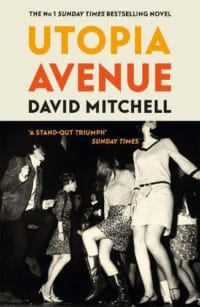
Book review: Utopia Avenue by David Mitchell
May 4, 2026

Utopia Avenue book cover

Like many people I discovered David Mitchell through his bestselling novel Cloud Atlas. I went back and read his first two books and declared myself a big fan. I bought his next few books as hardbacks on release and loved them. But then after 2014 I for some reason didn’t pick up his next two novels – until now.

Looking back at my notes from the talk Mitchell gave in Bristol in 2014, he said he was writing “a book largely set in 1960s London and New York, due for publication in 2016”. Well that surely has to be Utopia Avenue, which was finally published in 2020. And which I finally read last month.

This is a novel about a fictional band called Utopia Avenue in 1960s London (mostly). They’re a cross-genre hybrid formed by a visionary manager, Levon Frankland, bringing together musicians he’s individually impressed by. Which at first seems like a plan so misguidedly hopeful it can’t possibly work. As these five strangers gradually become a team, life throws curveballs that could end the dream before it’s begun.

Each chapter centres around the writing of a particular song, told from the perspective of the song’s writer. All the band members and their manager get a turn – though two of the band do the majority of the writing and therefore get more chapters. It’s an interesting way to tell the story, though I did occasionally want more from the perspectives that were largely missing.

Continue reading “Book review: Utopia Avenue by David Mitchell”
Kate Gardner Reviews

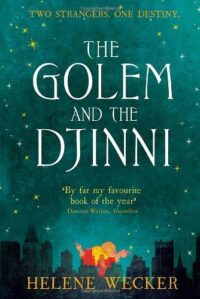
Book review: The Golem and the Djinni by Helene Wecker

January 24, 2024 1 Comment

The Golem and the Djinni book coverOver Christmas and New Year I had almost two weeks off work, so I thought I’d power through four or five books. I’d wrap up cosily from the world in chunky knits and soft blankets; move from bed to sofa to rocking chair; interrupted only by dog walks and meal times. Ha! I think I forgot that Christmas is also a time for trying to see all the family and friends for quality time. And that’s lovely, but does mean despite the truly terrible weather keeping the dog walks short, reading time was also short.

But I did finish one book, a 644-page saga with magical fantasy elements woven into an otherwise realist historical setting. And it was a great read that thoroughly absorbed me.

The Golem and the Djinni by Helene Wecker is, as the title suggests, about a golem and a djinni. Though mostly set in New York City in 1899, it also has scenes in what was then Prussia and locations in the Middle East that again straddle modern country borders. Manhattan is the perfect place for characters living in a Jewish neighbourhood with strong European roots and in Little Syria, with its Arabic roots, to encounter each other and discover that they have much in common.

Continue reading “Book review: The Golem and the Djinni by Helene Wecker”

Kate Gardner Reviews

Book review: The Forty Rules of Love by Elif Shafak

January 6, 2024January 5, 2024 1 Comment

Forty rules of love book coverI am not a big fan of the novel-within-a-novel device. Invariably I find the secondary narrative either too dull or too abstract to keep my attention, and my interest is only held by the primary story. I found it a little odd, then, that the opposite happened with The Forty Rules of Love by Elif Shafak.
Ella Rubinstein is a very average, middle-class white American housewife. Now that her three children are almost fully grown she’s got her first job in two decades, reading manuscripts for a literary agency. Her first manuscript is Sweet Blasphemy by A Z Zahara, a historical novel about the real-life 13th century poet and scholar Rumi and the time he spent with Sufi dervish Shams of Tabriz.

The story’s setting and characters are completely alien to Ella but she finds herself getting completely sucked in. To the extent that her relationships to her children and husband change entirely and she begins a secret e-mail correspondence with Zahara that quickly becomes flirty and romantic.

I can relate (to a point) as I also found myself fully absorbed by novel-within-a-novel Sweet Blasphemy. I’ve read a little of Rumi’s poetry and I’m very interested in new historical settings. I didn’t really know anything about 13th century Iran or Sufism. But most of all I was fascinated by Shams.

Continue reading “Book review: The Forty Rules of Love by Elif Shafak”

Kate Gardner Reviews

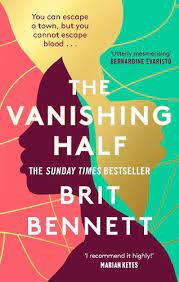
Book review: The Vanishing Half by Brit Bennett

August 20, 2023 1 Comment

The Vanishing Half book cover

The Vanishing Half by Brit Bennett enjoyed a lot of success and hype when it was first published. I’ve had it on my to-read list ever since, yet I had somehow managed to avoid not only spoilers but any idea of the book’s setting or themes. I quite enjoyed coming to this novel completely fresh, though I doubt it would have marred my pleasure to know more.

In August 1954, identical twin teenage girls Stella and Desiree disappear from the small town of Mallard, Louisiana. In 1968 one sister returns. The story starts from Desiree’s return in 1968, expanding both back and forward from that point to fill in their childhood, the missing years and the future. It is thus a decades-long story but told as a mystery rather than a saga.

Though the core of the story is blood relatives who have split apart to lead very different lives, this novel concentrates more on chosen family. The twins’ mother Adele, widowed young, loves Early – a man who comes and goes from her home and her life, but always come back and is in his own way a loving stepfather to the girls. They never marry and, despite the time and location, this is accepted. Later, her granddaughter chooses a relationship with another man whose only real flaw is that they cannot get married.

Continue reading “Book review: The Vanishing Half by Brit Bennett”

Kate Gardner Reviews

Book review: Neon Roses by Rachel Dawson

July 22, 2023 1 Comment

This is why independent bookshops are awesome. I probably would never have heard of Neon Roses by Rachel Dawson if my local bookshop Bookhaus hadn’t held an author event about this debut novel. Though I was unable to attend because I was unwell at the time (my lupus has flared up a little in the last month), the description in the Bookhaus email about the event sounded so good that a few days later I cycled over and bought myself a signed copy.
The story opens in a small coalmining town in South Wales in 1984. It’s the peak of the miner’s strike and Eluned is working all the hours she can to support her family, as her father’s strike wages have trickled to almost nothing, while also turning up to the picket lines and volunteering at fundraising events at the miners hall. It’s a lot, and her sister Mabli’s no help – swanning off with her Thatcher-supporting policeman boyfriend.

Continue reading “Book review: Neon Roses by Rachel Dawson”

Kate Gardner Reviews

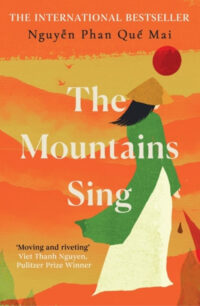
Book review: The Mountains Sing by Nguyén Phan Qué Mai

December 19, 2022December 19, 2022 1 Comment

The Mountains Sing book coverSometimes a book breaks your heart but you love it anyway. For me, The Mountains Sing by Nguyén Phan Qué Mai hit that spot. It’s a novel about Vietnam through most of the twentieth century, told through one family.
After a very brief prelude, it opens in Hanoi in 1972. Twelve-year-old Hương and her grandmother Diệu Lan are running to a bomb shelter as the air raid sirens sound yet again. Hương’s parents and uncles have disappeared down the Ho Chi Minh Trail to fight in the war. Years later, Hương can only hope no news is good news.

Hương and her grandmother decide they must walk up into the mountains with only the food and clothing they can carry, in search of safety from the American bombs. They return months later to a devastated Hanoi and must piece a life back together, including literally rebuilding their home.

This tale is interspersed with the story of Diệu Lan’s childhood further south, in central Vietnam. Like Hương has experienced in her short life, Diệu Lan had a happy, comfortable home until a series of invaders culminating with the Japanese unsettled everything, and then came the blow of the North Vietnamese Communists, who took an extreme, violent approach to redistribution of wealth.

Continue reading “Book review: The Mountains Sing by Nguyén Phan Qué Mai”

Kate Gardner Reviews

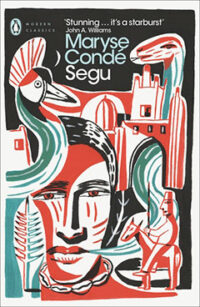
Book review: Segu by Maryse Condé

October 8, 2022 1 Comment

Segu by Maryse CondeI started this book in August for Women in Translation Month, but it turns out that historical epics take a while to read and even longer to process. Segu by Maryse Condé (translated by Barbara Bray) follows one family in the city state of Segu, in what is now Mali. Though they don’t all stay there, allowing the family saga to become epic in what it encompasses.

The story begins in 1797. Dousika Traore, trusted adviser to the king, has four sons by his various wives and concubines. (I have already forgotten whether he also has daughters, which I think speaks to how generally the women in this book are barely mentioned, though a few do get a bigger role.) They are wealthy, with a large home and money to pay the fetish priests to ensure the continuation of their good fortune.

The first dent in that fortune is the oldest son Tiekoro, who is intrigued by the newly arrived religion Islam – and in particular the access to knowledge that is provided by learning to read and write, a necessity in Islam that is forbidden for the rest of the Bambara (who make up the majority of Segu’s population). Most Bambara – including the king and his other advisers – are deeply suspicious of Islam and look down on Dousika when his son’s secret is revealed, but Dousika sees an opportunity to make strategic alliances through his son. The decision will reverberate through generations and Condé makes no clear statement as to whether Dousika’s choice was right, wrong or inevitable and therefore no choice at all.

The other major force of change is European colonialism. In 1797 the Atlantic slave trade is at its peak but soon Europeans will abandon it one by one and turn to other means of stripping resources from West Africa. Condé depicts the ways in which slavery was part of daily life for many West Africans, and how that is different from the industrial-scale torture introduced by the white men. She doesn’t depict the “local” slavery as good or acceptable, simply shows that it was a part of life at the time.

Continue reading “Book review: Segu by Maryse Condé”

Kate Gardner Reviews

A brief rain shower, sweeping swiftly across the valley, gently moistening the parched leaves

March 1, 2021

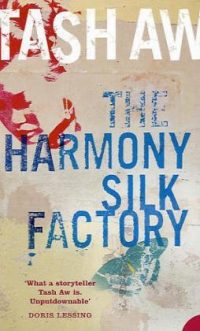
The Harmony Silk FactoryThe Harmony Silk Factory
by Tash Aw

This novel seemed to have all the right elements for me to love it, but I’m not sure I even liked it. I see a lot of Goodreads reviewers have called it 2/3 a good novel and I can see their point, but I think it fails long before the final section that others disliked.

Set in Malaysia, with its key events taking place in the 1940s, this is ostensibly the story of Jonny Lim, a poor country boy turned wealthy textile merchant, but his story is told through the lens of three narrators who all think they knew him far better than their accounts suggest is true. Was Jonny a Communist leader, a gangster, a murderer, a traitor? His son Jasper thinks so, but his account appears to be the least reliable of all.

Jasper is the first narrator. Following his father’s death, he is trying to piece together Jonny’s life from a combination of official documents, his own memories, rumours and a generous dose of his own imagination. His unreliability is so thickly laid on that I found it tedious rather than mysterious. There is some satisfaction to be had from seeing some of the events later through another perspective and finding a version of the truth that rings truer, but a lot of what Jasper covers is never revisited, so it can only ever be pure speculation.

Continue reading “A brief rain shower, sweeping swiftly across the valley, gently moistening the parched leaves”

Kate Gardner Reviews

She is only a human being for a tiny moment across the eternity of her servitude

October 6, 2020October 3, 2020

Underground Railroad book coverThe Underground Railroad
by Colson Whitehead

Not that I ever doubted it, but this book is excellent. It depicts many details of the awfulness of slavery while also being a highly readable adventure narrative. Please forgive the short review – this book deserves more analysis but it’s now a while since I read it and I just want to share my praise for it before I forget even more.

Cora is a slave in Georgia. She is an outcast of sorts among the slaves on the plantation, tarred by her mother’s reputation of madness and her own fierce protection of the tiny garden her mother left her. On the verge of adulthood, new threats raise their ugly head and an offer is made: does she want to attempt an escape with recently arrived slave Caesar? Her journey across America, making use of an underground railroad that is an actual railway underground, is astonishing, terrifying, entertaining and upsetting.

Continue reading “She is only a human being for a tiny moment across the eternity of her servitude”

Kate Gardner Reviews

A monk’s thoughts must be like a town defended by a sturdy wall

May 20, 2019

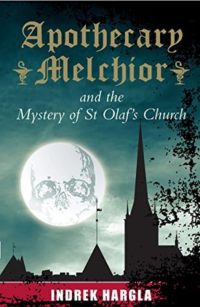
Apothecary Melchior and the Mystery of St Olaf's Church book coverApothecary Melchior and the Mystery of St Olaf’s Church
by Indrek Hargla
translated from Estonian by Adam Cullen

This is my fourth book completed for the EU Reading Challenge, and the first one that came from a recommendation I received after my initial blog post. So thank you to Kätlin (who is Estonian but lives in the UK) for suggesting this book. I’ve learned a little about the history of Tallinn and enjoyed a satisfying murder mystery to boot.

The setting is 1409 Tallinn, which at the time was not strictly part of Estonia, but a recent addition to the Holy Roman Empire. A preface sets the scene: Tallinn is a small coastal town finally enjoying growth and prosperity after a terrible band of pirates have been caught and punished. Christianity is central to everything. As well as having multiple churches of its own, a new castle on the hill overlooking Tallinn houses monks and holy knights.

It is in this castle, Toompea, that the story opens, with a drunken knight stumbling towards his gruesome murder (I should add that only the barest of details are given – this is not a grossout/medically-detailed crime novel). When the body is discovered, Tallinn’s town magistrate, Dorn, is called upon to catch the murderer quickly. He in turn asks his friend, the town apothecary, to help him investigate.

Continue reading “A monk’s thoughts must be like a town defended by a sturdy wall”

Kate Gardner Reviews

Posts pagination

1 2 3

Archives

RSS Nose in a book

  • Book review: Interstellar Megachef by Lavanya Lakshminarayan
  • May 2026 reading round-up
  • Book review: Passing by Nella Larsen

Me on the internets

  • @kate_in_a_book@mas.to (Mastodon)
  • Flickr/noseinabook
  • Instagram/kate_in_a_book
  • StoryGraph/kate_in_a_book

Categories

  • Blog
  • Reviews
  • Uncategorized
Proudly powered by WordPress | Theme: Dream by vsFish.