Nose in a book

Reviews and other ramblings

  • Home
  • Reviews archive
    • Book reviews
    • TV reviews
    • Theatre reviews
  • TBR
  • Challenges
    • The Classics Club
    • 2014 Popular-Science Reading Challenge
    • Cookery challenge
    • The Gilmore Girls Reading Challenge
    • 2013 TBR Pile Challenge
    • 2013 Translation Challenge
    • Crime and Punishment read-a-long
  • About
    • Cookie legal stuff
  • Home
  • Reviews archive
    • Book reviews
    • TV reviews
    • Theatre reviews
  • TBR
  • Challenges
    • The Classics Club
    • 2014 Popular-Science Reading Challenge
    • Cookery challenge
    • The Gilmore Girls Reading Challenge
    • 2013 TBR Pile Challenge
    • 2013 Translation Challenge
    • Crime and Punishment read-a-long
  • About
    • Cookie legal stuff

Tag: religion

The male and female together make the world
August 22, 2019August 22, 2019

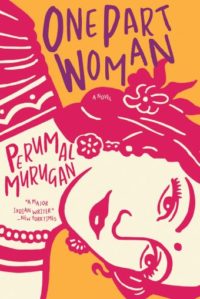
One Part Woman coverOne Part Woman
by Perumal Murugan
translated from Tamil by Aniruddhan Vasudevan

This novel is set in early 20th century India, focusing on a couple who are farmers in a rural area, steeped in religion and superstition. So it is perhaps surprising to find that it is one of the most relatable stories I have read in a while.

Kali and Ponna have been married for 12 years. They love each other and their little corner of Tamil Nadu, but their inability to conceive a child has come to overwhelm everything else. Ponna is excluded from the community, and even family flinch if she touches a child. Kali is alternately mocked and advised to take a second wife. They’re not sure they even want a child, but it seems to be all that the rest of the world cares about.

Their simple lifestyle means that the exact date when this is set was unclear to me, though references to British rule give at least some clue. (There are mentions of certain politicians and events that apparently reveal to those with better historical knowledge than mine that this is the 1940s.) So fertility treatment is limited even for those who have money and access to doctors.

For Kali and Ponna there are no doctors to help. Their only recourse is religion. They endlessly pray, visit shrines and temples, perform rituals. They search their family histories for wrongs done by their ancestors that they can put right. They spend their meagre income on offerings to deities. Hundreds of deities.

Continue reading “The male and female together make the world”
Kate Gardner Reviews

Braiding the parallel rays into a dappled pattern

August 19, 2017

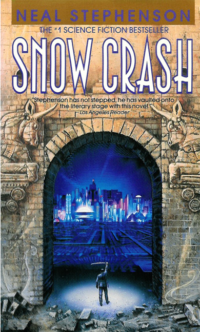
Snow Crash
by Neal Stephenson

Since its publication in 1992, this book has come to be considered a modern classic. I remember Tim reading it around 12 years ago and loving it – indeed, he still remembers it in remarkable detail. So in my ongoing science-fiction education, this seemed like a natural step.

This book has a fascinating setting that, though complex enough to be slowly revealed over 470 pages, is at heart simple enough to not require masses of exposition at the start. Instead, Stephenson opens with an action-packed sequence that introduces our main character – the aptly named Hiro Protagonist – and his foil, YT.

Hiro is a freelance hacker. His home is a storage unit that he shares with an up-and-coming rock star, a cramped situation that suits him fine because he spends most of his time in the Metaverse anyway – an alternative space that anyone with virtual-reality goggles and what is effectively an Internet connection by another name can plug into. In the Metaverse, your avatar can own property, socialise and explore in the vast space created many years ago by Da5id – superstar hacker and old friend of Hiro’s. In the Metaverse, Hiro is a sword-fighting expert, but in Reality (always written with a capital R) he delivers pizza to pay the bills.

Continue reading “Braiding the parallel rays into a dappled pattern”

Kate Gardner Reviews

Languages are different for a reason

July 20, 2016

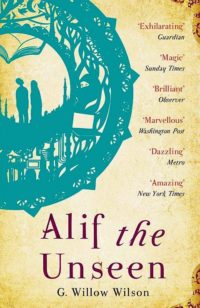
alif the unseenAlif the Unseen
by G Willow Wilson

I was eager to read more G Willow Wilson after discovering her writing in the Ms Marvel comics. This is a lovely easy read that deals with some pretty deep complex issues but manages to never feel like an “issues” novel. Which is a clever balancing act. It’s probably the fantasy elements that help keep it light and fun. Mostly.

The story follows Alif, a young man in an unnamed Arab Emirate who works as a “grey hat” – a skilled hacker who helps paying customers to remain hidden online. He keeps a vigilant watch for the state’s top internet security expert “the Hand” but is widely acknowledged to be the best and therefore safest from arrest. He is also conducting a secret affair with Intisar – secret because although they are both Muslim, their social classes are very different and neither set of parents would approve. But Alif is a romantic and assumes they will somehow find a way.

When the book opens, Alif (which is his screen name, not his given name) has not heard from Intisar (ditto) for two weeks and is trying not to worry about the possible reasons. Then the Hand manages to break most of the way through his computer’s encryption and he is suddenly at real risk of arrest. Friends help him out but there comes a point when he needs more than friendship – he needs another kind of aid entirely.

Continue reading “Languages are different for a reason”

Kate Gardner Reviews

Love should bestow sublimity

March 22, 2016March 24, 2016

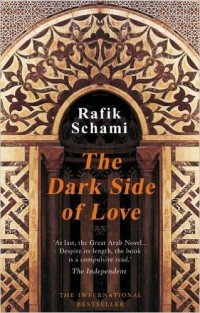
dark side of loveThe Dark Side of Love
by Rafik Schami
translated from German by Anthea Bell

I can’t remember where I first heard about this book but I do know it was on my birthday wishlist a few years back and I was surprised when I opened the parcel to find not a stack of three or four books, but one big fat book. It is epic in every sense of the word and I loved spending two weeks absorbed in it.

Rafik Schami writes in his afterword that ever since he was a 16-year-old boy in Syria, back in the 1960s, he had wanted to write a realistic Arab love story, but it took him 40-odd years to get it right. The result is a novel that looks at dozens of permutations of doomed romance against a backdrop of decades of Syrian history, though the bulk of the story is set in the 1950s and 1960s.

“Nagib looked askance at his daughter and smiled. ‘Why does love always have to imply possession?’ he asked, shaking his head…’You should love with composure…Love should bestow sublimity. It lets you give everything without losing anything. That’s its magic. But here people want a contract of marriage concluded in the presence of witnesses. Imagine, witnesses, as if it were some kind of crime…State and Church supervise the contract. That’s not love, it’s orders from a higher authority to increase and multiply.’ “

Continue reading “Love should bestow sublimity”

Kate Gardner Reviews

The existence of the jinn posed problems

December 29, 2015

two-years-eight-months-28-nightsTwo Years Eight Months & Twenty-Eight Nights
by Salman Rushdie

This has everything you might expect in a Rushdie novel: gods, religion, satire, myth, history, sarcasm and wordplay. But it is much more readable than the other novels of his that I have tackled (The Satanic Verses, Midnight’s Children, Shalimar the Clown, The Ground Beneath Her Feet). The tone is lighter, more comic, even though the topics are just as weighty.

The story begins in 12th century Spain, with exiled philosopher Ibn Rushd, also known as Averroes (who existed in real life and is the source of Rushdie’s family name). He falls in love with Dunia, who is secretly a jinnia (female jinn). She bears him dozens of children but he refuses to marry her and leaves her when his exile is lifted.

Skip 800 years and one of the Duniazát, as Rushd and Dunia’s descendents are called, has begun to float. Mr Geronimo is a gardener in New York City, just one of many victims of the “time of strangenesses” – the result of a war between the Jinn leaking into the human world. The normal rules of physics no longer apply.

Continue reading “The existence of the jinn posed problems”

Kate Gardner Reviews

Who am I to judge someone else’s holy site?

December 22, 2015

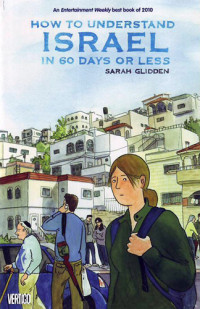
how to understand israelHow to Understand Israel in 60 Days or Less
by Sarah Glidden

Despite the grandiose title, this is the account of a small, albeit important, step in one person’s attempt to understand the complex situation surrounding Israel and Palestine. Told in comic-book style, it combines journalism and memoir to great effect.

Sarah Glidden is a “cultural Jew”. Raised in America by largely non-religious parents, her own politics being liberal and left-leaning, she has always tended to side against Israel, feeling it to be the political “bad guy”. A combination of a wish to understand, a hope to be proven right and the promise of a free holiday encourage her to sign up for a Birthright Tour. These trips, funded by the Israeli government and private sponsors, are open to Jews from around the world to show them the country that they can choose to move to if they so wish.

Sarah travels with her friend Melissa, another cultural Jew who is more earnest than Sarah in her attempts to learn about Israel without pre-judgement. Melissa’s upbringing was even more secular than Sarah’s, so Judaism itself is strange to her, but she is eager to learn and often frustrated by Sarah’s one-track mind: to every experience, every talk, Sarah asks “but what about the Arabs?”.

Continue reading “Who am I to judge someone else’s holy site?”

Kate Gardner Reviews

The Crucible at Bristol Old Vic

October 18, 2015

BOV_Crucible

“We are what we always were in Salem, but now the little crazy children are jangling the keys of the kingdom, and common vengeance writes the law!”

This classic play marks 100 years since the birth of its playwright Arthur Miller by returning to the stage of its 1954 British première (its true première was a year earlier, on Broadway). Directed by Tom Morris, artistic director of the Bristol Old Vic, the production is largely traditional, with a few unusual twists. The cast gathers faces familiar to the Bristol stage with those from farther afield, but there are no star names, which is to its credit. This play works well as an ensemble, allowing each character’s importance to the story be highlighted in turn.

Continue reading “The Crucible at Bristol Old Vic”

Kate Gardner Reviews

The superhero 12 miles from Manhattan

April 28, 2015April 29, 2015

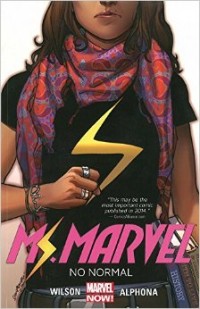
ms marvel vol 1Ms Marvel vol 1: No Normal
by G Willow Wilson (writer) and Adrian Alphona (artist)

When Marvel launched a new Ms Marvel series in February 2014, it got a fair bit of press attention for starring their first Muslim superhero. Add to that the fact that the series is edited and written by women, and cue a lot of clamour about how comic books are changing. What interested me more, though, was that it had a teenage female lead, making it effectively a coming of age story, and I’m a sucker for those.

Kamala Khan is 16 and lives in Jersey City in the US with her parents and older brother. She idolises the Avengers and resents the strict rules imposed by her parents and religion, but as rule-breaking goes she keeps it small, because she does want to honour her parents and her god. So it’s a big deal when she sneaks out of the house one night to attend a party. Of course that just has to be the one night that a mysterious green mist descends on Jersey City that does something decidedly weird to her.

Continue reading “The superhero 12 miles from Manhattan”

Kate Gardner Reviews

You’re just a totalitarian angel

December 22, 2014

AmorousDiscourseSuburbsHellAn Amorous Discourse in the Suburbs of Hell
by Deborah Levy

This is a long poem (ish – it’s no Faerie Queen) in the form of a dialogue between a couple, “He” and “she”, alternating having their say in this argument/conversation. It’s different from anything else I’ve read, wonderfully surreal and packed with references to everything from Shakespeare to pop songs. I read it in one sitting and immediately wanted to read it again.

The poem works so well because it could be read in many ways. Is this an ordinary human couple living in suburbia? Or are they angels fallen to hell? Is one of them fallen and the other trying to save them? Is one human and one God? The many religious references (to the Bible, to Dante, to the language of faith) are woven in such a way that they could just possibly be the twee fondnesses of a couple in love, or they could be wholly serious.

Best of all, it’s funny. Genuinely, laugh-out-loud but also cleverly, funny. It’s profound and profane, full of meaning and simple, pure entertainment.

“i try to introduce you
to the way i see things
and all you want is a wife
a wife and a second-class stamp and a bath
a bath and a donut and a product to kill moths

“You’re just a totalitarian angel
Full of self-rapture
I thought you were a divine messenger
In fact you’re a glutton
With wings”

First published 1990 by Jonathan Cape.
This edition, with revisions, published 2014 by And Other Stories.

Source: I subscribe to the publisher.

Kate Gardner Reviews

My first step from the old white man was trees

July 21, 2012

The Color Purple
by Alice Walker

When I read the first page of this book I wasn’t sure I could carry on. Walker plunges right into the heart of the awful beginnings of her story. But I made myself continue and within a few pages I was hooked.

The story is told in the form of letters, initially all addressed to God, from Celie. She tells how from the age of 14 she was repeatedly raped by her pa and bore him two children, both taken away from her. This has destroyed her ability to have further children so she is offloaded as a wife to Albert, a man looking for a trouble-free mother to his children. He beats her and makes no secret of his hate for her. Her beloved sister Nettie lives with them briefly before being forced to run away when she rejects Albert’s advances.

It’s all pretty bleak. And then along comes Shug Avery. The love of Albert’s life, she is a nightclub singer and quickly becomes Celie’s first real friend. Finally joy, happiness and the ability to talk openly come to Celie and she gradually finds the strength to make her life what she wants it to be.

Obviously, I knew this from reputation, but I realised it was a few chapters before it is clear that all the characters are black (at least, initially they all are). They are simply poor, ill-educated farm folk. But as Celie gets older and meets more people she learns what it means to be black. She learns about black people in other cities, other countries and even other continents. And she learns about being a woman, how she doesn’t have to be subservient.

Although the book goes very firmly from dark to light, it never gets over-sentimental or mawkish. Celie’s matter-of-fact tone gradually gains humour and worldliness. Always observant, she reports the moments and the conversations that have made her who she is at the end of the story:

“I believe God is everything, say Shug…My first step from the old white man was trees. Then air. Then birds…it come to me: that feeling of being part of everything…And I laughed and I cried…It sort of like you know what, she say, grinning and rubbing high up on my thigh.
“Shug! I say.
“Oh, she say, God love them feelings. That’s some of the best stuff God did…
“God don’t think it dirty? I ast.
“Naw, she say. God made it. Listen, God love everything you love &ndash and a mess of stuff you don’t. But more than anything else, God love admiration.
“You saying God vain? I ast.
“Naw, she say. Not vain, just wanting to share a good thing. I think it pisses God off if you walk by the color purple in a field somewhere and don’t notice it.”

Now, I’m not religious, but there was something very moving about Shug’s idea of God and I love how it freed her and later Celie to follow their own rules. Not to give too much away, but this book includes some frank talk about sex and some homosexuality, not to mention all of the affairs characters keep having. Which I hadn’t expected and found refreshing. Yes, these are poor black people in the segregated southern USA in I think the 1930s and 1940s (there’s some vague talk about war breaking out in Europe) but take away the poverty and politics and they’re still human beings with hearts to give and break and libidos to follow.

The style of writing took some getting used to. Beside the dialect, Celie doesn’t always name characters or explain a situation clearly until much later. And time was passing far more quickly than I realised. There are sometimes years between letters. Also, the absence of speech marks was sometimes confusing. But looking beyond all that, it is a wonderful book well worth the pain of the early chapters.

First published in the USA in 1983 by Harcourt Brace Jovanovich.
Winner of the Pulitzer Prize.

Kate Gardner Reviews

Posts pagination

1 2

Archives

RSS Nose in a book

  • Book review: Interstellar Megachef by Lavanya Lakshminarayan
  • May 2026 reading round-up
  • Book review: Passing by Nella Larsen

Me on the internets

  • @kate_in_a_book@mas.to (Mastodon)
  • Flickr/noseinabook
  • Instagram/kate_in_a_book
  • StoryGraph/kate_in_a_book

Categories

  • Blog
  • Reviews
  • Uncategorized
Proudly powered by WordPress | Theme: Dream by vsFish.