Nose in a book

Reviews and other ramblings

  • Home
  • Reviews archive
    • Book reviews
    • TV reviews
    • Theatre reviews
  • TBR
  • Challenges
    • The Classics Club
    • 2014 Popular-Science Reading Challenge
    • Cookery challenge
    • The Gilmore Girls Reading Challenge
    • 2013 TBR Pile Challenge
    • 2013 Translation Challenge
    • Crime and Punishment read-a-long
  • About
    • Cookie legal stuff
  • Home
  • Reviews archive
    • Book reviews
    • TV reviews
    • Theatre reviews
  • TBR
  • Challenges
    • The Classics Club
    • 2014 Popular-Science Reading Challenge
    • Cookery challenge
    • The Gilmore Girls Reading Challenge
    • 2013 TBR Pile Challenge
    • 2013 Translation Challenge
    • Crime and Punishment read-a-long
  • About
    • Cookie legal stuff

Tag: science

Book review: The People in the Trees by Hanya Yanagihara

July 18, 2025

the people in the trees book cover

I have had The People in the Trees by Hanya Yanagihara on my to-read list since it was published more than 10 years ago. It was her first novel, before the worldwide phenomenon that was her follow-up A Little Life. Which I read and loved, but it is devastating, and I think that made me delay reading more from her. And it has to be said that this book also deals with heavy, shocking themes. I think it’s brilliant, but it is not an easy read.

On the first page we are told that the main character, Dr Norton Perina, has been arrested and charged with rape, statutory rape, sexual assault and endangering a minor. What follows is his protege Ronald Kubodera’s attempt to exonerate him, wrapped around Perina’s memoir written from prison. Kubodera does not claim the offences didn’t happen. He thinks everything Perina has done is justified. It is an unsettling angle from which to approach the story. And it is also extremely clever, because it allows Yanagihara to show both the full extent of Perina’s awfulness and the fact that he truly did not see any problem with his own actions.

Perina is an American doctor who, we are told, won the Nobel Prize in Medicine in 1974 for discovering a medical condition that retards ageing. This condition existed only in a remote tribe in a Micronesian island country called U’ivu. We also learn that over a period of decades, Perina adopted 43 children from U’ivu and raised them in the US. It isn’t hard to connect the dots between the facts revealed in the first two pages, but the full horror isn’t revealed until near the end of the novel’s 360 pages.

Continue reading “Book review: The People in the Trees by Hanya Yanagihara”

Kate Gardner Reviews

Space itself: a straight line from every point to every other point

October 2, 2020October 1, 2020

Measuring the World book coverMeasuring the World
by Daniel Kehlmann
translated from German by Carol Brown Janeway

This is my Austria book for my EU Reading Challenge. It’s the fictionalised story of two real German scientists whose lives and work intersected, despite their very different backgrounds and temperaments.

Carl Friedrich Gauss and Alexander von Humboldt are unlikely stars for a comedy, but Kehlmann’s style leans towards the comedic. He also shows a fascination with facts and scientific process, which makes these two men a great choice for him.

Humboldt and Gauss both did work mapping and measuring the physical landscape – distances and heights primarily. For Gauss this was unwelcome, unpleasant work that forced him to be outdoors and interact with people in return for food and shelter. He much preferred to be at home with his beloved wife observing the stars and calculating the maths that governed their movements.

Continue reading “Space itself: a straight line from every point to every other point”

Kate Gardner Reviews

The chemistry and physics on which we fed were the antidote to Fascism

July 30, 2019July 31, 2019

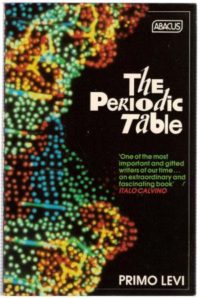
The Periodic Table book coverThe Periodic Table
by Primo Levi
translated from Italian by Raymond Rosenthal

This is my Italy book for my EU Reading Challenge and is also on my Classics Club list. It seemed appropriate right now in multiple ways. I’ve seen a few people recommending we all read Primo Levi this year to remind us what Fascism and Second World War concentration camps were like (to refute the argument that the US detainment camps aren’t really concentration camps). Plus, 2019 is the International Year of the Periodic Table of Chemical Elements, as designated by UNESCO.

This is a difficult book to describe. Not quite a memoir, but not quite popular-science either, and certainly more than just a loose collection of tales. Each of its 21 chapters is framed around one element – sometimes abstractly, sometimes very directly. Levi was a professional chemist and himself describes this book as “events, mine and otherwise…to convey to the layman the strong and bitter flavour of our trade…stories of the solitary chemistry…which with few exceptions has been mine: but it has also been the chemistry of our founders…who confronted matter without aids, with their brains and hands, reason and imagination.”

Levi begins with his ancestors and a dissection of the language he spoke as a child, a product of the Jewish community in the Piedmont region that combined Italian, Piedmontese and Hebrew. I’ll admit that the link is a little tenuous between the inert gas argon and Levi’s assessment of his ancestors’ general character, but I do love a bit of etymology and Levi has a knack for turning anything into a great story.

Continue reading “The chemistry and physics on which we fed were the antidote to Fascism”

Kate Gardner Reviews

Women’s inventions have been neglected by evolutionary researchers

April 7, 2019

Inferior book coverInferior: the True Power of Women and the Science That Shows It


by Angela Saini

This is such an important book. It’s not the first on this topic but it’s the one that has managed to take off and get the message out there (partly thanks to the brilliant Jess Wade, who has been campaigning to get this book into school libraries).

Saini interrogates the claims of scientists about the differences between the sexes. She explains what we do and don’t know about whether men and women’s different positions in society are the result of physical biological differences, or hard-wired differences in ability, or if they’re the result of hundreds, if not thousands, of years of society and culture being skewed.

Are men’s and women’s brains really wired differently? It’s a very complicated area of science, and despite some excitable newspaper headlines, we don’t yet know for sure. It appears that there is more variety within each sex than there is between them. And importantly, even if there are physical differences, we have to be extremely careful about extrapolating reasons for those differences.

Can we learn about our ancestors from anthropologists’ studies of 20th-century hunter-gatherers? A limited amount, yes, but the surviving hunter-gatherer communities are all very different from each other. The only real conclusion we can reach is the variety of what human beings – and women particularly – are capable of.

But that hasn’t prevented more than a century of evolutionary research being skewed to ancient hunting habits (because men were presumed to have done most of the hunting) and often ignoring or downplaying other human activities such as gathering food and childcare (which were assumed to be wholly female activities). Which has knock-on effects including that theories about the development of human language are largely based around hunting and it is only recently that scientists have begun to question whether a more likely scenario for language development is the need to pass information from mother to child.

Continue reading “Women’s inventions have been neglected by evolutionary researchers”

Kate Gardner Reviews

Absorbed by the whiteness

December 19, 2018January 6, 2019

White
by Marie Darrieussecq
translated from French by Ian Monk

I added this to my wishlist when it was first published in English, on the back of a blog review (probably Savidge Reads, but I now forget). It was always going to appeal to me: scientists and engineers in Antarctica, international collaboration, humour and romance. But somehow it stayed sat on my wishlist for years.

Earlier this year Tim and I finally made it to Shakespeare & Co in Paris (we’d been to Paris before but hadn’t squeezed in the bookshop). I wanted to buy something translated from French and this title immediately came to mind. Amazingly, it was right there in their surprisingly small translated-from-French section. Of course, this means it has the awesome Shakespeare & Co stamp on the title page so I was never going to get rid of the book no matter how it turned out. But thankfully I do really like it.

The story (written in 2003) is set in a near future where people communicate via 3D holograms, the first manned mission is on its way to Mars, and the first permanent European base in Antarctica is under construction. (This last, arguably the entire basis for the story, does betray some lack of knowledge of Antarctic history – unless the translator has omitted the key modifier “pan-European”, which would be a first. Several European countries have their own permanent Antarctic bases.)

Continue reading “Absorbed by the whiteness”

Kate Gardner Reviews

Do you Zooniverse?

February 25, 2018

I’ve spent years hearing about Zooniverse, right back to its origin in the Galaxy Zoo project, but it occurred to me that outside of academia and science journalism, maybe it’s not so well known. Zooniverse is a citizen-science platform, where anyone can register and help to sort through the types of data that are easier for humans to classify than computers.

That might sound dull, but most projects involve looking at photos and ticking a box for each one. You can choose between dozens of projects to find something that you will enjoy looking at photos of. There’s Cheetahs of Central Namibia, where the photos are from a camera trap in a Namibian national park. There’s the Weddell Seal Count, where the images are from a satellite pointed at sections of ice in the Antarctic. There’s the Milky Way Project, with images from the Spitzer Space Telescope and WISE satellite observatory.

One I got a little obsessed with last year is Penguin Watch, where you click on every penguin in each photo. I love penguins and it’s reassuring to see photos of hundreds of them just getting on with their quiet little lives.

Continue reading “Do you Zooniverse?”


Kate Gardner Blog

Gedanken fictions

July 24, 2017

Just a quick post to say that my review of Thought X: Fictions and Hypotheticals, edited by Rob Appleby and Ra Page, has been published over on the Physics World website. It’s a collection of short stories and essays about thought experiments in physics and philosophy, and I found it fascinating. The fiction authors include Zoe Gilbert and Robin Ince, while the accompanying essays are by scientists including Seth Bullock and Tara Shears.

To see what else I thought, hop on over to Physics World.


Kate Gardner Blog

Do not allow your mind to be imprisoned by majority thinking

April 4, 2017 3 Comments

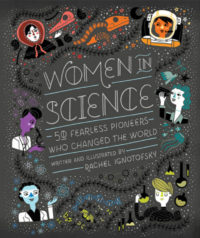
Women in Science: 50 Fearless Pioneers who Changed the World
by Rachel Ignotofsky

We tend to think that until the latter half of the 20th century, science was done by men. The history books and allocation of awards such as Nobel prizes strongly support that view. But in recent years a slew of books have begun to challenge that version of history. This is the first I’ve read but I’m keen to follow it up with Hidden Figures, The Glass Universe and others.

Ignotofsky both wrote and illustrated this beautiful book, profiling women scientists in a design-heavy layout that simply and effectively tells their stories.

From Hypatia (approx 350–415 AD) to Maryam Mirzakhani (1979–present), this book devotes a double-page spread each to women who have made significant advances in science, technology, engineering and mathematics (STEM). In each, the left-hand page is an illustration of the woman herself, with a few key facts floating around, while the right-hand page contains a bio of the woman and a few small, light-hearted illustrations. In every case there is a quote either by or about the woman, and these often reference being a woman in a man’s world.

Continue reading “Do not allow your mind to be imprisoned by majority thinking”


Kate Gardner Reviews

Sunday Salon: All culture is here (except the bits that are elsewhere)

March 20, 2016

The Sunday SalonIt’s been a bit busy of late. This weekend I’ve finally had a chance to relax after the crazy that was last weekend. We crammed a lot of stuff into too short a time, and my energy levels are showing it. So shockingly (or not) I still haven’t written any of those long-promised book reviews. I have, however, done lots of fun cultural stuff I thought I might share.

We kicked off with a gig here in Bristol. Local rock band Reef were playing what I thought was a reunion tour, but it turns out they’ve been back together since 2010 and I just hadn’t noticed before. Still, it was a great night. Tim and I relived the Reef gig we went to together about 12 years ago and wandered home late on a balmy spring evening. Spring is teasing us with its gradual arrival this year but I think it might just have got here now.

Next up we headed to London. We spent an afternoon at the Science Museum, mostly in the Cosmonauts exhibition (which ended last Sunday) but we also caught a couple of photography shows there. All were excellent, but especially Cosmonauts, which follows the Russian space story.

Continue reading “Sunday Salon: All culture is here (except the bits that are elsewhere)”


Kate Gardner Blog

A man is no better for having made the worst journey in the world

August 19, 2015September 13, 2015

worst journey in the worldThe Worst Journey in the World
by Apsley Cherry-Garrard

Wow. Just wow. Perhaps I’m biased by my pre-existing fascination with polar exploration, but this is an incredible book. Or rather, it reaches the very limits of credibility but does not overstep them, for I do not think that Cherry exaggerates at all. Humans beings have been through worse at the hands of other human beings, but not at the hands of nature.

This is a big book, but I tore through it in less than a week, foregoing most of my television and internet-pottering time because I just had to get back to this gripping story. For a day after finishing it I was reluctant to start another book or experience any other story. I wanted to sit with this tale of hardship and suffering in the name of science, of men who willingly endured that humankind might benefit. It is inspiring.

Continue reading “A man is no better for having made the worst journey in the world”


Kate Gardner Reviews

Posts pagination

1 2

Archives

RSS Nose in a book

  • Book review: Interstellar Megachef by Lavanya Lakshminarayan
  • May 2026 reading round-up
  • Book review: Passing by Nella Larsen

Me on the internets

  • @kate_in_a_book@mas.to (Mastodon)
  • Flickr/noseinabook
  • Instagram/kate_in_a_book
  • StoryGraph/kate_in_a_book

Categories

  • Blog
  • Reviews
  • Uncategorized
Proudly powered by WordPress | Theme: Dream by vsFish.